

SanDisk Corporation (SNDK) shares plunged 14% in afternoon trading on Thursday, hitting a session low of $1707.58 as investors rotated out of artificial intelligence chip and memory hardware stocks and shifted capital into AI software companies.
The decline followed an extraordinary first half of 2026, during which SanDisk shares surged roughly 858%, leaving the stock vulnerable to profit-taking as market sentiment shifted.
The selloff came despite recent analyst upgrades that pointed to improving fundamentals.
SanDisk had gained nearly 5% on Tuesday after Bernstein raised its price target on the stock, but the broader weakness across semiconductor and memory names outweighed the positive outlook.
Sector-wide rotation pressures memory stocks
SanDisk was not alone in Thursday’s decline. Memory storage companies including Micron Technology and Western Digital also posted sharp losses as the sector entered what market participants described as a technical correction.
The combination of profit-taking following SanDisk’s substantial rally from its 52-week low of $40.10, weakness across the semiconductor sector, and pressure on technology shares contributed to the stock’s outsized decline.
Despite the pullback, SanDisk continues to trade well above its 52-week low, while analysts maintain price targets significantly above current trading levels.
Analysts remain positive on long-term outlook
Wall Street analysts continued to express confidence in SanDisk’s longer-term prospects despite the sharp decline.
On June 30, Bernstein analyst Mark Newman raised his price target to $3,000 from $1,700 while maintaining an Outperform rating.
The firm cited new long-term supply agreements featuring fixed or range-bound pricing and upfront financial commitments, which it believes reduce earnings volatility.
Separately, Bank of America analyst Wamsi Mohan reiterated a Buy rating on Wednesday and increased his price target to $2,500 from $2,100.
“We expect supply/demand imbalance in the NAND market to remain through 2027,” Mohan wrote in a client note, adding that pricing should hold up through mid-2027.
Mohan projected June-quarter revenue of $9.1 billion and earnings per share of $37.01, exceeding both consensus estimates and the company’s guidance range of $7.75 billion to $8.25 billion in revenue.
China supply risks and technical picture remain in focus
Even with the constructive outlook, analysts continue to monitor supply risks from China.
Mohan identified Yangtze Memory Technologies Co. (YMTC) as a key long-term risk, noting that additional supply could pressure NAND pricing sooner than expected.
His base-case outlook assumes the company will primarily serve domestic Chinese customers.
Industry analyst Ming-Chi Kuo also commented on the memory market over the weekend, stating that the “memory supply-demand gap will keep widening through 2027.” Kuo also said Apple Inc. is lobbying the US administration regarding ChangXin Memory Technologies (CXMT) to secure additional DRAM supply sources.
From a technical perspective, SanDisk continues to trade above its 20-day, 50-day and 200-day simple moving averages, while the moving-average structure remains in a bullish alignment.
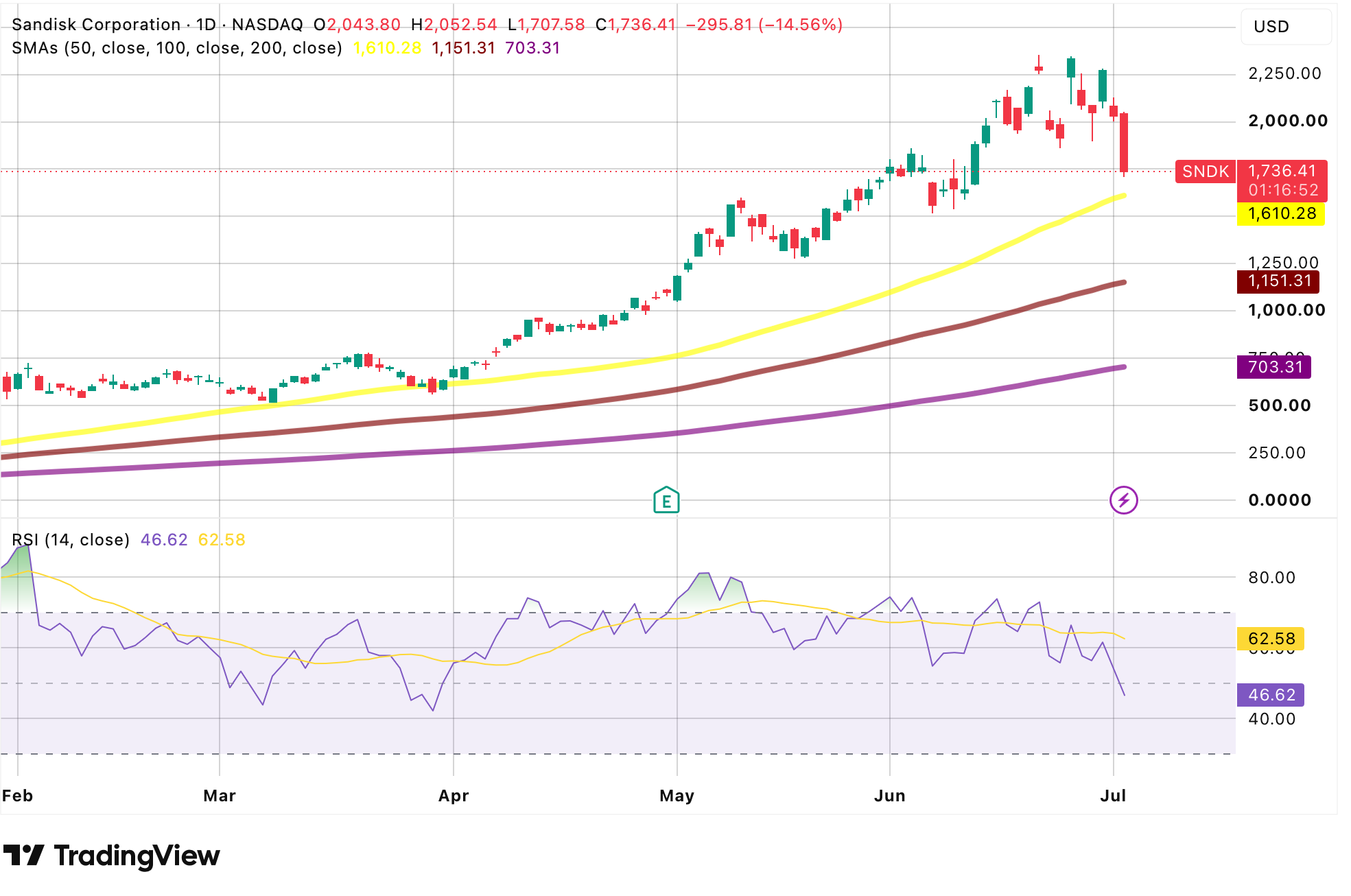
The stock’s relative strength index stood at 46.62, indicating more balanced momentum following the recent pullback.
The latest decline reflects broad-based profit-taking in AI hardware stocks rather than company-specific developments, as investors rotated into AI software names despite continued bullish forecasts from Wall Street analysts.